
Newsweek recently published an article entitled Striking It Rich: Is There An App For That?. While it's an interesting read, it's the typical post-hype tear-down article. Since the opening of the iTunes App Store, the press has relentlessly hyped the "get rich quick selling iPhone apps" story. Well, I guess the story has played out; now the tear-down begins.
It seems Newsweek has discovered that not everyone instantly strikes it rich. In fact, it takes most of us a lot of work, a bit of risk and more than a little perseverance to bootstrap a new business. And even successful iPhone developers in the hit-driven gaming segment are worried about how well their next game will sell. With a different tone, the article would actually be an interesting exposé on high tech entrepreneurship, but Newsweek writer Tony Dokoupil gives the piece an air of dejection and disillusionment.
David Barnard of App Cubby, who is featured in the article, wrote an interesting rebuttal (warning: contains a cute baby picture at the end).
iPhone developer Bjango also recently posted a rebuttal in their blog.
Monday, October 12, 2009
Friday, October 9, 2009


Wednesday, October 7, 2009
Building iPhone Apps with HTML, CSS, and JavaScript
O'Reilly has published a pre-print HTML version of the book Building iPhone Apps with HTML, CSS, and JavaScript by Jonathan Stark.
Building iPhone Apps with HTML, CSS, and JavaScript covers web apps vs. native apps for iPhone, styling HTML for the iPhone, animation, client-side data storage and offline application caching.
This book looks like it's going to be a valuable resource for both iPhone SDK app creators and web developers who want to target iPhone users.
Building iPhone Apps with HTML, CSS, and JavaScript covers web apps vs. native apps for iPhone, styling HTML for the iPhone, animation, client-side data storage and offline application caching.
This book looks like it's going to be a valuable resource for both iPhone SDK app creators and web developers who want to target iPhone users.

Tuesday, October 6, 2009
Objective-C Tuesdays: The for loop
Welcome to the first episode of Objective-C Tuesdays. We'll be focusing on C and Objective-C basics. Today we will look at the standard C language
The
The
Initialization The initialization expression is where the starting value of the loop counter variable is set. The initialization expression is evaluated once before the
Condition The condition expression is evaluated before each iteration; the loop continues while the condition evaluates to
Action The action expression is evaluated at the end of each iteration, after the condition and the body of the loop are executed. The action is typically used to increment or decrement the loop counter, but can be used to perform any action that makes sense for your code. Most of the time, you simply want to increment the counter by one:
Example Putting this all together, here's some Objective-C code to count from 0 to 5 and back to zero:
Next week, we'll look at some of the crazy and complicated ways you can use the
for loop.The
for loop is the most flexible looping statement in C, and the most common. It groups all the important loop information together at the start of the loop, making it quick and easy to both read and write.The
for loop statement starts with the keyword for, followed by parentheses containing the loop definition. The loop definition contains three expressions separated by semicolons: initialization, condition and action. After the parentheses, a single statement or block makes up the body of the loop./* for loop with a single statement */
for (initialization; condition; action) statement;
/* for loop with a block */
for (initialization; condition; action)
{
block;
}Watch out for a hard to spot bug when the for loop is followed by an empty statement created by an extra semicolon:for (initialization; condition; action); /* <-- warning! empty statement! */
{
/* this block is not part of the loop */
/* it's always executed exactly once */
}Initialization The initialization expression is where the starting value of the loop counter variable is set. The initialization expression is evaluated once before the
for loop begins executing. Loop counters are commonly integer types, but can be any type that makes sense in your code. In modern versions of C and Objective-C, the loop counter can be declared in the initialization section as well. The loop counter is typically given the name i (or j or k in nested loops). In C99 and later, initialization looks like: for (int i = 0; condition; action)In older versions of C, the loop counter must be declared somewhere before the
for loop: int i; /* ... */ for (i = 0; condition; action)
Condition The condition expression is evaluated before each iteration; the loop continues while the condition evaluates to
true or non-zero and stops when the condition evaluates to false or zero. The condition expression is often a "less than" (<) or "less than or equal to" (<=) expression: for (int i = 0; i < 10; action)or
for (int i = 1; i <= 10; action)but it can be any expression that makes sense in your code.
Action The action expression is evaluated at the end of each iteration, after the condition and the body of the loop are executed. The action is typically used to increment or decrement the loop counter, but can be used to perform any action that makes sense for your code. Most of the time, you simply want to increment the counter by one:
for (int i = 0; i < 10; i++)but other increments are easy to do:
for (int i = 0; i < 10; i += 2)
Example Putting this all together, here's some Objective-C code to count from 0 to 5 and back to zero:
for (int i = 0; i <= 5; i++) {
  NSLog(@"%i", i);
}
for (int i = 4; i >= 0; i--) {
  NSLog(@"%i", i);
}
The output looks like this: 0 1 2 3 4 5 4 3 2 1 0
Next week, we'll look at some of the crazy and complicated ways you can use the
for loop.
Monday, October 5, 2009
Orchard's Craps now available in the iTunes App Store
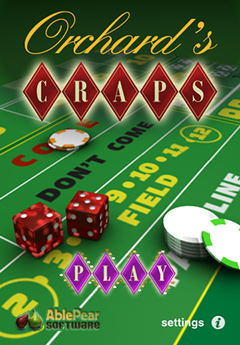 Able Pear is very happy to announce that our latest application, Orchard's Craps, is now available in the iTunes App Store.
Orchard's Craps is an iPhone and iPod touch version of the classic casino dice game and is the first of in the Orchard's Casino series of games.
Orchard's Craps features include:
- Animated 3D dice with sound
- Real stickman calls for rolls
- Horn and Hard Ways bets
- Adjustable minimum bet, maximum bet and pass line odds
- Standard casino craps table rules
We hope you enjoy playing Orchard's Craps as much as we enjoyed creating it!
Click here to see our complete list of apps.
Friday, October 2, 2009
iPhone Friday - October 2, 2009
It's Friday, and with it comes new iPhone and iPod touch wallpapers. This week is the third installment of the Hubble Space Telescope set (links after images).


Hubble Space Telescope sets:
iPhone Friday, October 18, 2009 - HST Set 1
iPhone Friday, October 25, 2009 - HST Set 2
iPhone Friday, October 18, 2009 - HST Set 1
iPhone Friday, October 25, 2009 - HST Set 2
Subscribe to:
Posts (Atom)





 Posts
Posts

